





Reinforced concrete pools: durability, design freedom & value
Dream Pool Design Costa Rica
Share this:
Building a pool in Costa Rica means making decisions you feel today—but you’ll either pay for (or appreciate) for years. One of the most important is the structural system.
While prefabricated and fiberglass options exist, reinforced concrete pools remain—across most projects—one of the most reliable and versatile choices for Costa Rica’s conditions. Not because it’s a trend, but because it makes technical sense: tropical climate, variable soils, and year-round use.
Why the structural material matters in Costa Rica
Costa Rica puts outdoor structures under real stress. A pool must perform in conditions such as:
- High, constant humidity
- Intense rainy seasons
- Very different terrain by region (flat lots, slopes, fill areas)
- Continuous use (not just “summer season”)
In this context, a pool needs long-term structural stability, proper waterproofing compatibility, and the ability to handle demanding conditions without becoming a constant source of adjustments or repairs.
What a reinforced concrete pool is
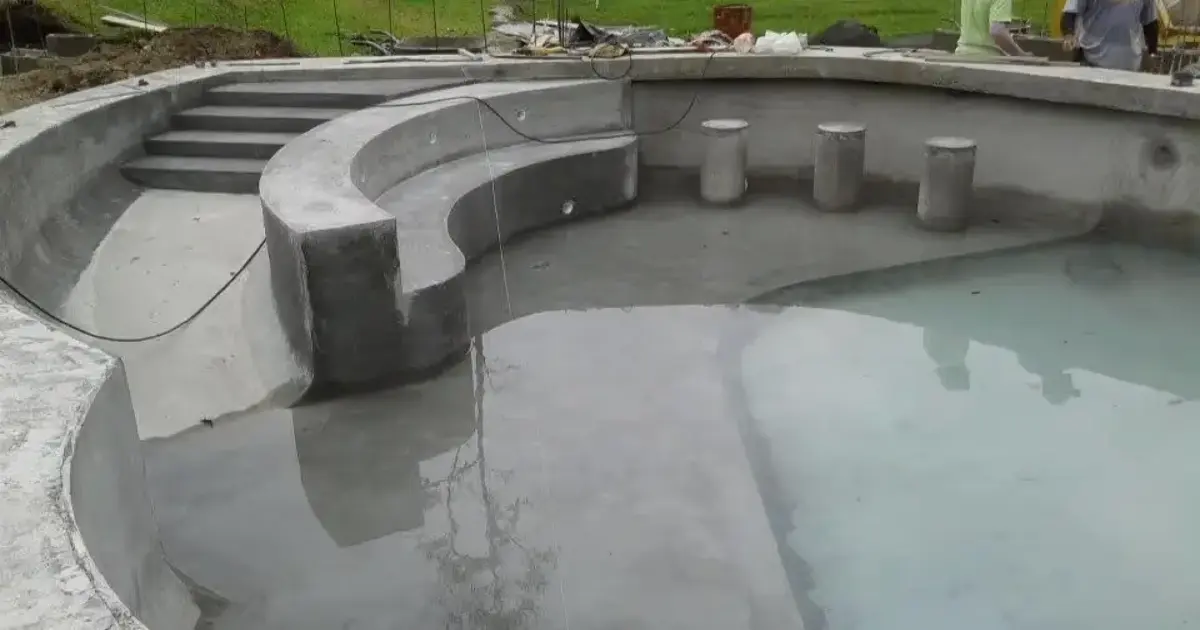
A reinforced concrete pool is built on-site, customized to the property and the project design. At a high level, the process includes:
- Excavation based on the design
- Steel reinforcement (rebar)
- Concrete placement/pouring
- Waterproofing and final finishes
This approach creates a solid structure designed for hydraulic loads and better prepared to handle certain ground variations—provided the engineering and execution are done correctly.
Real advantages of concrete pools in Costa Rica
1) Long-term durability and structural stability
A well-designed, well-built concrete pool can deliver a very long service life. Compared to some lighter systems, concrete tends to:
- Hold its shape better over time
- Tolerate intensive use more effectively
- Allow more “solvable” structural repairs when performed properly
Important: durability depends more on engineering, waterproofing, and workmanship than on concrete alone.
2) Full design freedom
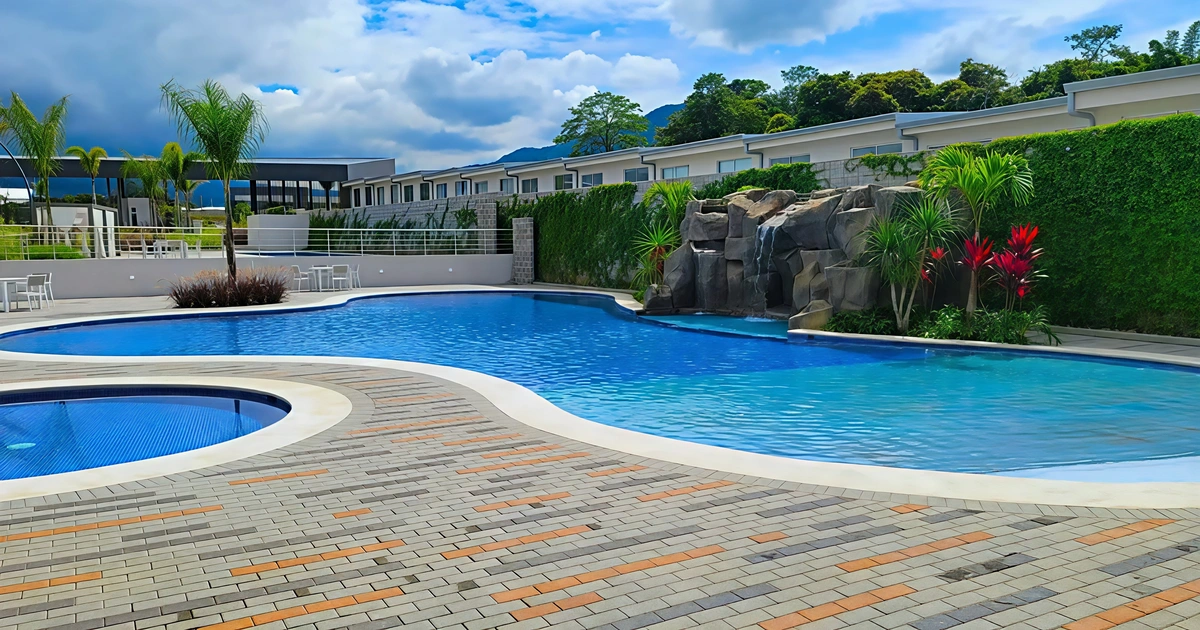
Concrete allows truly custom design:
- Irregular or bespoke shapes
- Multiple depth profiles
- Integrated steps, benches, and spa zones
- Infinity edges and architectural details
This is especially valuable for residential, condo, and hospitality projects—where design is part of the property value and guest experience.
3) Compatibility with premium finishes
Concrete supports many of the finishes commonly used in Costa Rica, such as:
- Glass mosaic
- Vitreous tile
- Pool-rated porcelain
- Premium specialty finishes
That flexibility helps align the pool with the project’s architectural style and long-term maintenance expectations.
4) Better adaptation to variable terrain
In a country where every lot can be different, building on-site makes it easier to adapt to:
- Slopes and elevations
- Machinery access limitations
- Specific soil conditions
When the terrain is challenging, that adaptability can be a major advantage.
How it compares to other systems
Prefabricated and fiberglass pools can be viable in certain scenarios, but in Costa Rica they often involve trade-offs such as:
- Limitations in shape and size
- Greater dependence on specific access/installation conditions
- More restrictive repair options depending on the system
That’s why, when the site is complex or the design is highly customized, concrete often offers clear advantages.
Are concrete pools more expensive?
Upfront cost can be higher in some projects, but the right way to evaluate it is total cost over time.
What often balances the investment:
- Long service life
- Fewer “corrections” when built properly from the start
- Flexibility to remodel, upgrade finishes, or improve equipment later
Final recommendation
If you want a durable, adaptable pool designed for Costa Rica’s conditions, reinforced concrete remains one of the best long-term choices. The key isn’t simply “using concrete”—it’s doing it with proper engineering, quality materials, correct waterproofing, and professional execution.

Helpful guides
Continue with these articles to make smarter decisions on design, equipment, and maintenance.