





Infinity Edge Pools: When They’re Worth It—and When They’re Not
Dream Pool Design Costa Rica
Share this:
What Is an Infinity Edge Pool?
Infinity edge pools are a modern design icon—especially in hotels, premium homes, and projects with spectacular views. However, they’re not always the best decision from a technical, functional, or financial standpoint.
In Costa Rica—where rainfall patterns, wind exposure, and site conditions can vary significantly—an infinity edge must be chosen with clear criteria. When it’s forced into the wrong context, it can become a high-cost, high-maintenance system to operate.
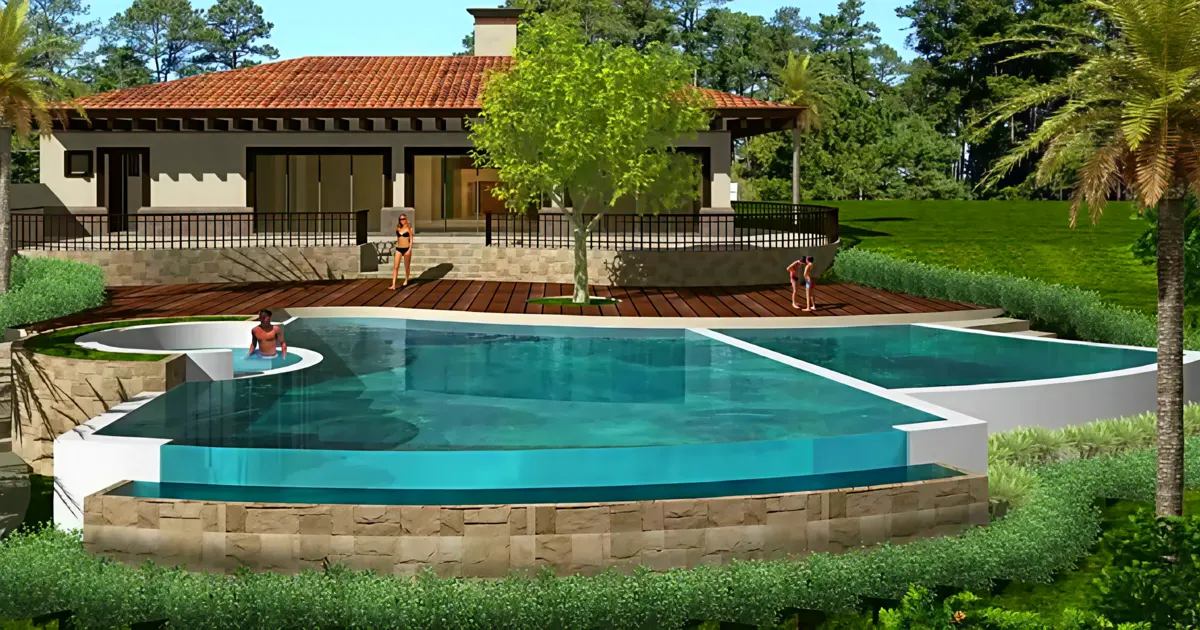
An infinity edge pool is designed so that one or more edges allow water to flow continuously into a hidden overflow channel, creating the visual effect that the water extends toward the horizon.
What an Infinity Edge System Requires
An infinity edge is not “just a beautiful edge.” It typically requires:
- Precise structural engineering (levels and tight tolerances)
- A dedicated overflow channel
- A balance tank (compensation tank)
- Continuous hydraulic and water-level control
When an Infinity Edge Pool Is a Great Idea
1) When there is a dominant view
An infinity edge makes sense when you have:
- Ocean views
- Open landscapes (valley, lake, mountain)
- A visible horizon or natural elevation drop that enhances the effect
Without a clear view, the visual impact is reduced—and the added cost becomes difficult to justify.
2) When the site supports it
Infinity edges perform best on sites that are:
- Sloped
- Naturally terraced
- Structurally favorable
Forcing an infinity edge on a completely flat lot often requires additional construction work, increasing cost without delivering the same benefit.
3) When the project needs real differentiation
For hotels, luxury villas, and premium residences, an infinity edge can:
- Increase the perception of exclusivity
- Add commercial value (marketing and guest experience)
- Differentiate the property from similar alternatives
When an Infinity Edge Pool Is Not Recommended
1) When the budget is limited
Infinity edges typically involve:
- Higher construction complexity
- More hydraulic components
- More precision in finishes and leveling
- Higher operating and maintenance costs
If the budget is tight, there are strong design alternatives that deliver high impact with less complexity.
2) When there’s no meaningful “horizon” or view
If the pool faces:
- A nearby wall
- Dense vegetation with no visual opening
- A setting without depth or an open landscape
The infinity edge becomes an “expensive overflow,” not a true visual experience.
3) When realistic maintenance isn’t planned
To perform properly, an infinity edge requires:
- Regular cleaning of the overflow channel
- Precise water-level adjustments
- Ongoing checks of the balance tank and controls
- More consistent oversight than a standard pool
Without proper maintenance, the effect is lost and the system becomes unstable.
Key Technical Considerations in Costa Rica
Heavy rain and water-level control (rainy season)
During the rainy season, the system must:
- Handle high inflow volumes without uncontrolled overflow
- Prevent sediment and debris from being pulled into the channel and tank
- Protect the hydraulic system and technical access points
Wind and evaporation (coastal areas)
Along the coast, wind can affect:
- Water “mirror” stability
- Water consumption (splash-out and evaporation)
- Hydraulic efficiency at the overflow edge
These factors should be addressed in the design: orientation, hydraulic strategy, and operational planning.
High-Impact Alternatives to Infinity Edges
In many cases, you can achieve a stunning result with less complexity, for example:
- Perimeter overflow pools
- Mirror-style water designs
- Raised edges with premium finishes and strong lighting
- Landscape integration (terraces, decking, lighting, planting)
Final Recommendation
An infinity edge pool can be spectacular—when it’s designed for the right context. The key is evaluating views, site conditions, intended use, budget, and realistic maintenance before deciding. In Costa Rica, solid technical guidance makes the difference between a great investment… and a costly system to operate.

Helpful guides
Continue with these articles to make smarter decisions on design, equipment, and maintenance.